THE QUICK ANSWER
Edge curl and layer separation are found by checks that carry a period, and a sample reviewed in one sitting carries none. Settle four lines in the brief: the joining method the quoted price assumes, the perimeter detail drawn on the specification, a flatness check run on a mat packed the way production will pack it, and the cleaning routine written as a cycle count with a pass condition. Set the durations and limits yourself; a blank hands them to whoever fills it in later.
The one check on this mat a sample review cannot run
Our development record for a litter trapping mat fixes six values: finished size, cell or groove depth, total thickness, backing material, finished weight and packed carton volume. It lists three checks: trapping by a stated method, emptying access, and edge curl after shipping. The six values can be measured on a finished sample and its carton. So can two of the three checks. Edge curl after shipping cannot, because a mat that has not been packed, shipped and unpacked has not met the condition the check names. That is the gap to close in the brief, and it closes with three things on one line: what is measured, over how long, and against what limit. Write those three and the check becomes a result someone owes you on a date. Leave them out and edge curl stays an opinion formed after the goods have shipped.
Ask which joining method the quoted price assumes
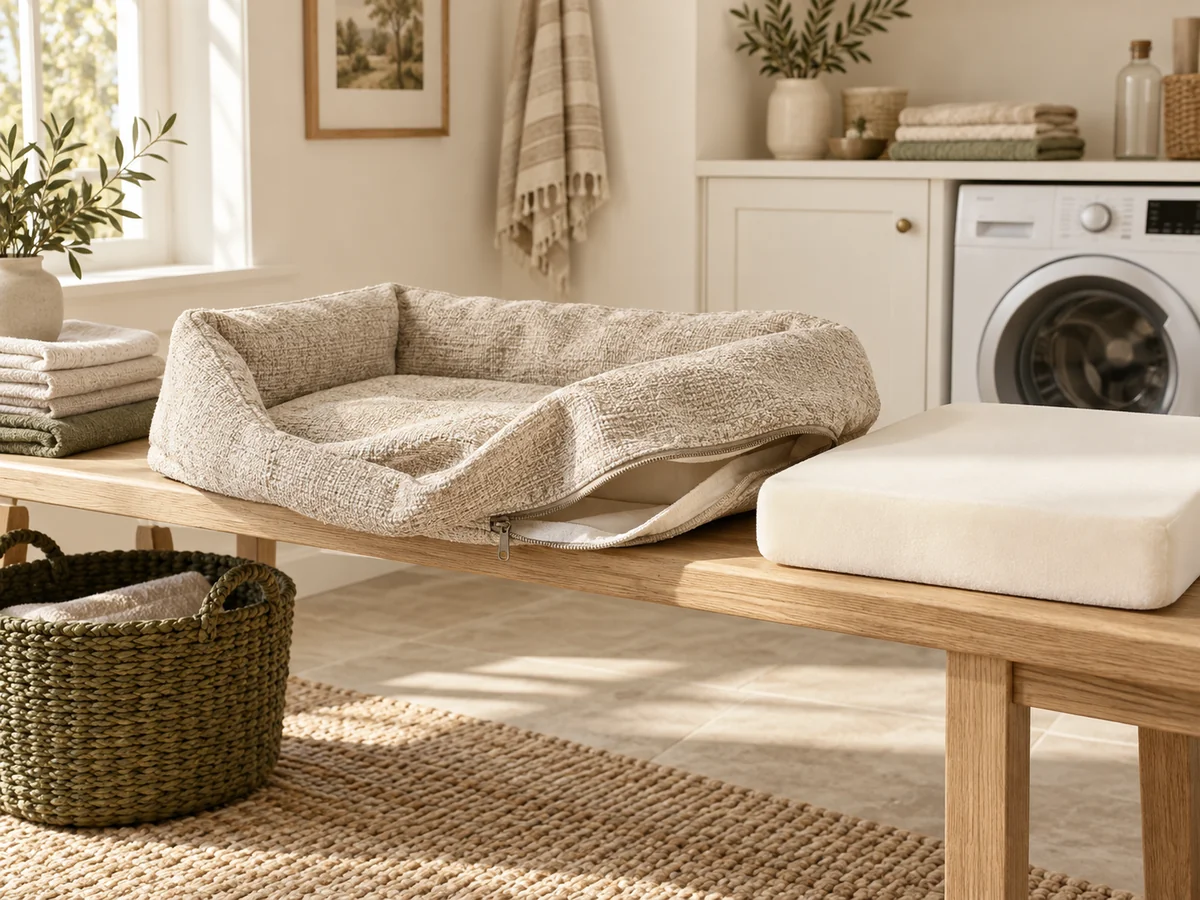
Our construction line for this mat reads: moulded trapping surface, optionally with a second layer and a side opening. It names no method for holding two layers together, and that silence is the question to put in the RFQ. If the mat you are quoting has a second layer, something joins those layers at the perimeter, and the quotation should say what. Ask for it in writing as a named method, with the material named where one is used, and ask for the perimeter detail to be drawn on the specification rather than described in an email. Two quotations that differ on this line are not two prices for one product, and until the line is filled in you cannot tell whether they differ. We publish no ranking of joining methods and hold no peel or cycle data of our own. Our rule for moulded parts still applies: lock it before the mould is cut.
Write edge curl as a measurement, a period and a limit
An acceptance criterion has three parts. What is measured: the gap between the underside of each corner and a flat surface, recorded in millimetres at all four corners. Over how long: a period you state, running from the moment the mat is unpacked. Against what limit: a figure you write in. We publish no figure here, because we can point to no published or recognised test standard for flatness on a moulded pet mat, and a number without a method is exactly what this site tells buyers not to accept. Set your own and state it, because a blank line is not neutral; it hands the decision to whoever fills it in later. Run the measurement twice, once with the mat unloaded and once carrying the weight it carries in use, and record both against the approved sample. Then require the same two figures on the first production lot, which is what keeps the criterion alive past sampling.
The pack is an input to the flatness check
A flatness check is only as good as the sample it runs on. If production ships the mat rolled, a check run on a flat-packed sample answers a different question. So state the pack in the brief: flat, rolled or folded, the roll diameter or the fold positions, the packed carton volume, which is already one of the six values fixed for this mat, and a requirement that the checked sample was packed and unpacked that way. Shipping method belongs in the same conversation. We ship by sea, air or express, matched to order size and deadline, and that is agreed in the written quotation; the pack has to be agreed alongside it rather than after it. If the pack changes later, the flatness result no longer describes the product you are buying and the check has to run again. Write that consequence into the brief so the change cannot be made quietly.
The cleaning routine, written as a cycle count with a pass condition
The care line we publish for this mat is short: shake out and rinse, and confirm the surface releases fine litter. That is a routine, and a routine can be written as a test. State the number of shake, rinse and dry cycles the construction has to survive. The count is yours to set; we publish none. State the drying position with it, so the check names one position rather than leaving it to whoever runs it. Then write the pass condition as observations rather than adjectives: no separation started at any point on the perimeter, no water held inside a hollow layer, the backing still attached at the corners, the surface still releasing fine litter. Last, do not print a care instruction the construction has not been run through. That has to be settled before artwork is locked, not after.
One piece or two layers: what each one asks you to own
We will not tell you which construction traps better. Our own limit on this SKU is written down: trapping claims need a stated test method, and percentage figures without one are not usable. That rule binds us before it binds a supplier. So choose on the open questions instead. A single moulded piece has no joint between layers, which takes the joining method off the check list; it also gives up the second layer and the side opening, and its dimensions are fixed once the mould is cut. A two-layer construction with a side opening keeps the emptying access and the interior, and in exchange you own the joining method, the perimeter detail and a cavity that water can enter and has to leave again. Neither is the safe choice in general. Pick against the question you can least afford to leave open on your range, then write that question into the brief as a check with a date.
The same blank sits in other product checks, and the figure is yours
Read across our development records and the pattern repeats: the check is written, the figure is not. The drying towel, also Grooming, is checked for shrinkage after wash cycles. Training pads, Grooming as well, are checked for edge leak under load. A collapsible travel bowl in the Feeding range is checked for rim set after a stated collapse cycle count. The cooling mat sits in Resting and is checked for seam weld integrity under load. A snuffle mat, in Play, is checked for base distortion after wash. Every one of those names a condition and stops short of a number, because the number belongs to the range and the price point you are building rather than to us. The line to paste into the RFQ is the same each time: state the method, state the duration or cycle count, state the limit, and report the result against the approved sample and the first production lot.
A useful comparison
| RFQ line | What you state | What a good answer contains |
|---|---|---|
| Joining method | Whether the mat has a second layer, and by what named method the layers are held | The method named, the material named where one is used, and the perimeter drawn on the specification |
| Edge detail | The perimeter finish you require, drawn rather than described | A marked-up drawing returned, not a yes in an email |
| Flatness | Gap under each corner in millimetres, unloaded and loaded, after a period you state | Both figures recorded against the approved sample and repeated on the first production lot |
| Pack | Flat, rolled or folded, with the roll or fold geometry and the packed carton volume | Confirmation that the checked sample was packed and unpacked that way |
| Cleaning cycles | Your cycle count, the drying position, and the pass condition as observations | A written pass condition, and pack care copy that matches it |
| Sample stage | Which sample the checks are run on | Stock-item custom sample within 7 days once artwork and details are confirmed; fully custom within 15 days once the specification is confirmed |
| Commercial terms | MOQ against your assortment, sample and tooling charges, shipping method | A written quotation. Typical MOQ is 100-500 units; where it lands depends on the product and the changes you ask for |
Explore private-label product options.
Slicker brush — materials, customization and sample checks Nail clipper — materials, customization and sample checks Drying towel — materials, customization and sample checksSources and research context
This guide sets out our own product development practice rather than external research. It makes no market, clinical or comparative-performance claim, and every figure named here is confirmed per order in the written quotation and specification.
How we research and writeTURN THE ANSWER INTO AN OEM BRIEF